
Strategy used to be a solo act. People had titles like ‘VP Strategy’ or ‘EVP, Strategic Planning.’ There were entire departments devoted to strategy.
Now, where strategy exists, it almost always has a buddy: Strategy & Transformation, Insights & Strategy, Strategy & Finance. In other cases, strategy has vanished altogether but we suspect it might be in there somewhere, perhaps in more prosaic titles like ‘SVP, Growth.’
Where did strategy go?
It failed as a standalone function. In company after company, central strategy groups were disbanded and distributed to divisions. What happened?
--
The Problem(s) with Strategy
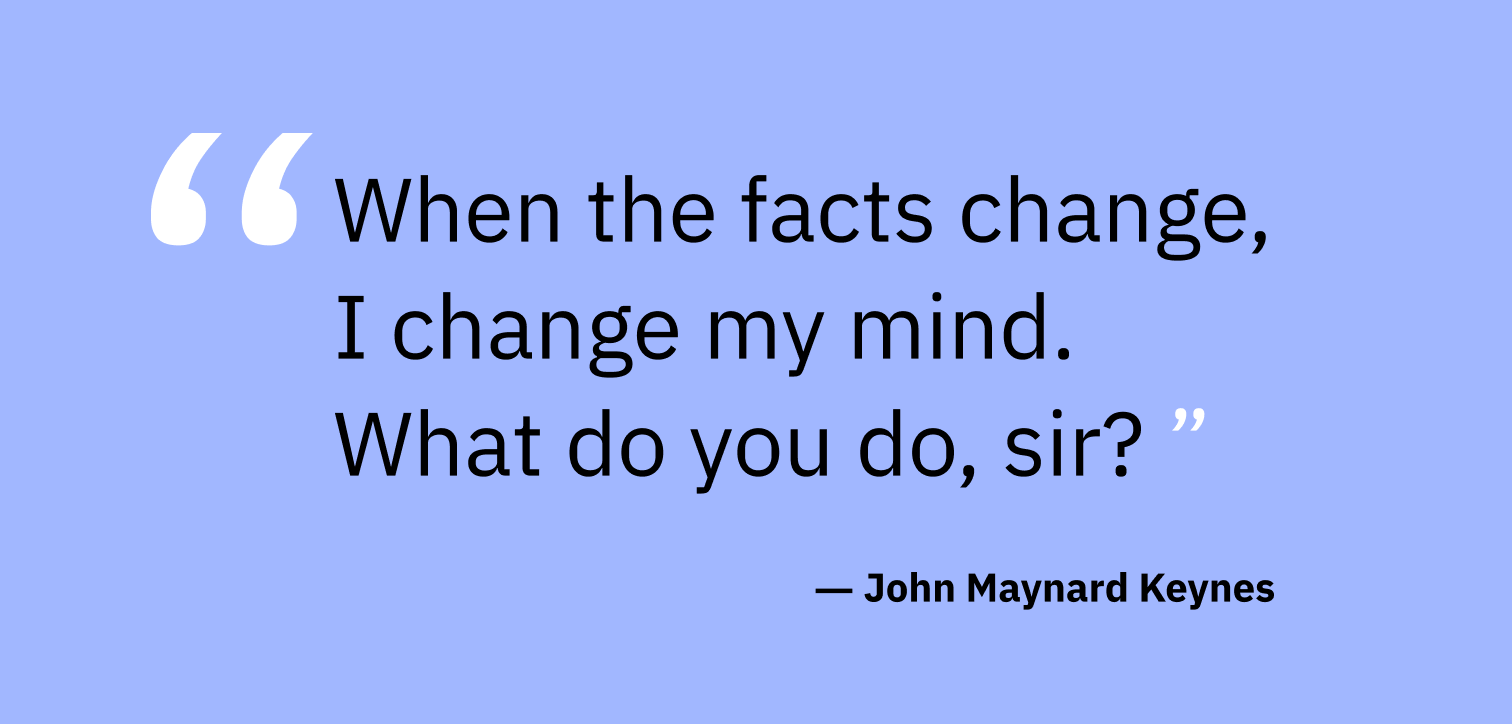
One of the biggest problems with strategy: evidence.
You may be thinking, really? Evidence is a problem? Aren’t those strategy slide decks jammed with statistics about industry size and customer surveys about interest in new products?
Yes, they are, but almost all of that evidence is only suggestive of success, leaving every proposed strategy dragged down by risk. What's missing is evidence that a new strategy is going to work.
But there’s another problem, and it has to do with change.
Most strategy doctrine is based on embedded but unstated leaps of faith: for starters, you have to believe the environment for a new strategy will stay pretty much the same. Competitors will keep doing what they’re doing. Customers will behave the way they said they would in that survey. Supply chains will stay put.
Which is the other big problem with strategy: traditional strategy depends on a static view of the world. Up until recently, it didn’t matter that your focus group data was six months old because behavior and attitudes were pretty static.
That’s no longer the case. We are in a time of exponential change, and it’s complicated by massive geopolitical and societal shifts. Everyone has to move a lot faster—including strategists.
--
Let's Go With Product Concept #2
.jpg)
Faster strategy needs better data: real-time, real-world, and ideally proprietary. It’s starting to happen: strategists are building toolkits that give them powerful data delivered fast. Sometimes it’s about speeding up old sources, and sometimes it’s just a matter of seeing unconventional data sources in a new light.
Hedge funds figured this out years ago. They don’t give a rip about keeping data in its lane. They buy so-called alternative data—retail-store inventory logged by secret shoppers, ground temperature monitoring, biometrics—and it gives them an edge in spotting trends they can trade on.
Hedge funds may know that your company’s strategy is going to succeed or fail before you do.
For most strategists, though, old habits die hard. There’s still a lot of love for survey and focus group data, in spite of their biases. But, thanks to more uncertainty and the need for speed, teams are starting to embrace experiments and other market-feedback methods that are faster and of higher quality.
We’ve spent the last decade or so developing a way to run market experiments that generate empirical data about strategic options. The data we generate is fast, multivariate, behavioral, and a real-life snapshot of how customers respond to something new—a brand strategy, a new product, positioning, even a logo.
Until a few years ago, our work was a hard sell. But we’ve seen company after company recognize the need for a dose of reality in strategy—evidence delivered quickly to drive smart decision-making.
No business operates in a static environment. The better the signals—like real-life data—the better the strategy.